

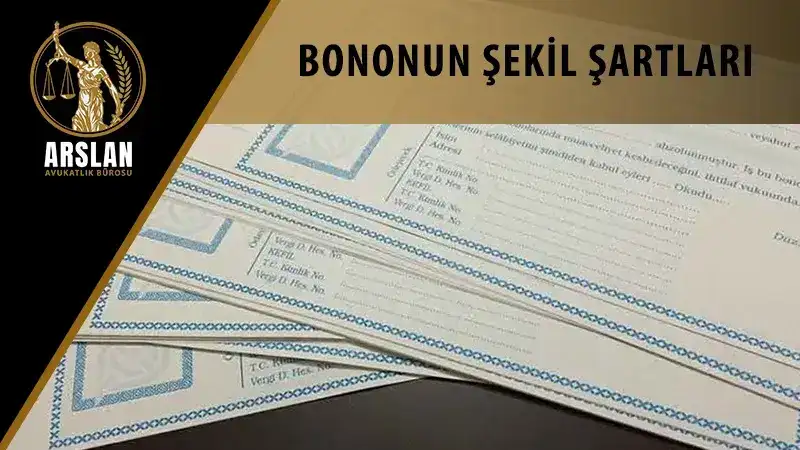
Form conditions of the bill
The bill is not defined in the Turkish Commercial Code. When the relevant articles are examined, a bill can be defined as a bill of exchange that contains an unconditional and unconditional promise of payment.
LEGAL FORM CONDITIONS
The formal conditions of the bill are listed in Article 776 of the Turkish Commercial Code. Relevant article;
"1) Bill or promissory note;
b) An unconditional promise to pay a certain price,
c) Maturity,
d) Place of payment,
e) The name of the person or to whose order it will be paid,
f) Date and place of issue,
g) Contains the signature of the organizer.".
In line with the text of the law, the mandatory form requirements that must be present in the bond will be listed as follows.
1-BONO OR THE WORD WRITTEN EMRE
The word "bill" or "promissory note" must be included in the promissory note text. If a bill issued in a language other than Turkish is encountered, it will be checked whether the word corresponding to the bill in that language is included in the bill text.
2- PROMISE TO PAY A CERTAIN PRICE WITHOUT CONDITIONS
The bill price must be included in the bill text. This price must be stated clearly and its numerical value must be written precisely. It is not necessary to write the price in TL.
3-TERM
There is no maturity-based form requirement in the bond. In other words, failure to specify the maturity will not render the bill invalid. "A bill whose maturity date is not shown is considered a bill that must be paid when seen." TTK 776/2
Prohibition of Installment Bills: It should be emphasized that; TTK m. In accordance with Article 703, issuance of the bill in installments is strictly prohibited. A bill whose maturity is fixed in installments (for example, stating that the price will be paid in parts in different months) loses its status as a bill of exchange and becomes an ordinary receivable document (beginning of evidence).
Maturity types in bonds can be examined under 4 headings.
MATURITY TYPES
a-When seen:
Bills issued in this way are payable upon presentation. The submission period is one year from the date of issue. If the one-year period expires, the holder loses his/her right to apply.
b-After a certain period of time:
These are bills that contain 20 days after sighting or another record. If the maturity is determined in this way, the period will start from the date of submission. In this case, the submission period is one year. The added period is calculated from the 1-year submission period. If this period expires, the holder loses his right to apply. The drawer writes the date of presentation on the bill. If it is not written, a protest can be made and the submission date can be determined.
c-A certain period of time after the regulation day:
As an example, a bill issued as "43 days after the date of issuance" can be shown. Here, the period will start from the day the bill is issued.
d-On a specific day:
It means the precise regulation of the maturity. Around 18.08.2022.
4- PAYMENT LOCATION
776/1 of the Turkish Commercial Code. Paragraph d of the article states that the place of payment will be indicated on the bill. However, this place of payment is not a mandatory form requirement. A bill whose place of payment is not specified will not be considered invalid.
TTK 777/3 "If there is no clarity, the place where the bill is drawn up is deemed to be the place of payment and also the place of residence of the drawer." It is in the form.
If there is a deficiency in both the place of payment and the place of issue in a bill, this time TCC 777/4. The article will find application. Relevant article"A bill whose place of issue is not shown is deemed to have been issued in the place written next to the name of the issuer." It is in the form.
5- BENEFIT
The beneficiary (the person to whom or to whose order the payment will be made) must be shown in the bill. As a rule, the bill is issued to the order of a third party. However, TCC art. TTK article sent by 778. In accordance with Article 678, it is also legally possible to issue the bill 'at the issuer's own disposal' (bill at his own disposal). In this case, the bill becomes valid when the drawer endorses the bill and puts it into circulation. On the other hand, the bill cannot be issued to a third party account (directly to someone else's account, not through a representative).
6- DATE AND PLACE OF ISSUE OF THE SECURITIES
The issuance date of a bill must be shown. Otherwise, there will be a violation of the mandatory form requirements of the bill and the bill will become invalid. The Supreme Court of Appeals did not require that the date of issuance in the bond be real. Promissory notes issued before or after the issuance date are also valid.
The bill whose place of issue is not shown is TTK 777/4. In accordance with the article, it will be deemed to have been issued in the place written next to the organizer's name. The place of organization must be specified as an administrative unit. There is no harm in shortening the place of arrangement. For example, Istanbul is the place of issue for a bill. Abbreviation may be used.
7- SIGNATURE OF THE EDITOR
TTK has deemed signature as a condition for the validity of the bill. In other words, signature is a mandatory form requirement. Article 779 of the Turkish Commercial Code holds the person who issues the bill as liable as the person who accepts the bill.
The signature on the bill must be made by hand. In case of a bill issued by more than one person, the signatures of all the drawers must be present. A decision of the 12th Civil Chamber of the Supreme Court of Appeals on the subject is as follows:
"For the bill to qualify as a bill of exchange, the signature must be made in the handwriting of the debtor. However, it is understood that the signatures of the drawer-debtor are stamp signatures. Since the stamp signature on the bill is not a wet signature of the debtor, the promissory note in question, which does not contain the signature element, is not a bill that has the qualification of a bill of exchange." 2016/13343 K.
Signatures written on the front of the bill by anyone other than the issuer are considered valid. One of the most common disputes in practice is double signatures made by company officials. According to the established jurisprudence of the Supreme Court; If the company official puts a signature on the front of the bill with the company stamp and a second signature outside the stamp, this second signature outside the stamp is considered aval (guarantee). In this case, the authorized person not only incurs debt to the company, but also becomes jointly responsible for the debt with his own assets.
It is possible to issue the bill through a representative. But the representative must state this situation. Otherwise, he will be personally responsible. In commercial enterprises, the commercial representative can sign the bill.
OPTIONAL ELEMENTS OF THE BILL
Some optional conditions can be added to the bill (e.g., 'the price has been received in cash/money' record or authorization condition). The printed bill documents sold in stationery stores often contain maturity statements such as 'If this bill is not paid on maturity, subsequent bills will also become due.' However, according to the established jurisprudence of the Supreme Court, the maturity records included in the bill are deemed not written (invalid). This registration does not affect the validity of the bill, but has no effect in terms of foreign exchange law; In other words, failure to pay a bill does not automatically make other bills due.
DEED OF REMEMBERMENT
There is a fundamental relationship underlying bills of exchange. This relationship can be a debt relationship or a reciprocal relationship. If the relationship under a bill of exchange is a bond of exchange, this bill is called a bill of exchange.
In promissory notes, the issuer of the promissory note does not have any debt to the beneficiary of the promissory note. In other words, the beneficiary has no real receivables. Therefore, a goodwill bond is a non-refundable bond.
When a promissory note is drawn up, an agreement is made between the drawer and the beneficiary stating that no claims can be made due to the promissory note. If the beneficiary requests payment from the organizer, the organizer will avoid the payment by asserting his/her beneficiary defense. The point that should be noted here is that if the certificate of remembrance is transferred to a third party, the issuer cannot claim the defence of remembrance against the third party.
In practice, it is frequently encountered that commemorative bonds are put into circulation. If there is any doubt that the promissory note will be put into circulation, the issuer may file a no-price lawsuit against the beneficiary.
OPEN NOTE
TTK's 680/1. According to the article, an open bond is a bond that is put into circulation without its elements being complete. Again, the same article does not impose any restrictions regarding the mandatory form requirements of the open bill. For this reason, it is possible to create an open bill only if it bears the signature of the issuer. It should not be forgotten that there is an agreement between the issuer and the beneficiary behind the open bill. The beneficiary can fill the bond according to this agreement.
The turnover of an open bond is the same as a full bond.
Transfer requires turnover + transfer of possession. If the open bill has been filled contrary to the terms of the agreement, the issuer can only prove this claim with written evidence. In case the bill is transferred to a third party in violation of the agreement, the issuer can only claim the violation of the agreement if the holder acquired the bill in bad faith or is seriously at fault. If there are no conditions, breach of agreement cannot be claimed against third parties.
LACK OF FORMATION CONDITIONS OF THE BILL
When a bill with no maturity date is seen, it is considered a payable bill.
If the place of payment is not shown, the place of issue is considered the place of payment.
A bill whose place of issue is not shown is deemed to have been issued at the place written next to the name and surname of the issuer.
Hukuki Danışmanlık ve Destek
Yukarıda yer alan makalemiz genel hukuki bilgilendirme amacıyla hazırlanmıştır. Somut davanız veya hukuki uyuşmazlığınız ile ilgili profesyonel avukatlık hizmeti almak için bizimle iletişime geçebilirsiniz.