

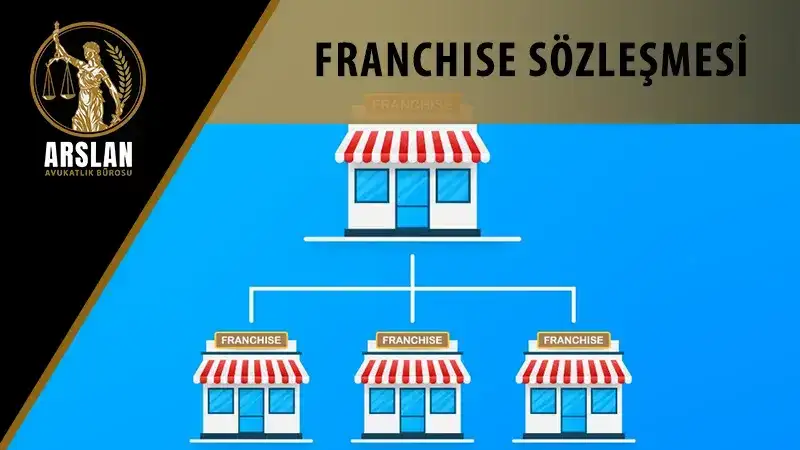
Franchise agreement
The word Franchising, derived from French, does not have an exact equivalent in Turkish. The dictionary meaning of the word in English is privilege.
The franchise system is a system developed to make globalization advantageous. Consumers' tendency towards reliable brands has pushed entrepreneurs to the franchise system. The system was first used in England and then quickly spread to many countries, especially the USA. The use of franchising in Türkiye is considered new. The franchise system was not found in Türkiye until the 1980s. The International Franchising Association (URFAD), founded in 1991, has been effective in spreading the use of franchises in our country.
In the communiqué numbered 1998/7 issued and repealed by the Competition Board, "Franchise: It refers to a system consisting of intellectual and industrial property rights regarding brands, trade names, store signs, utility models, designs, copyrights, know-how or patents to be used for the resale of goods or provision of services to end users." It is stated as follows.
The Supreme Court has defined the franchise agreement as "a set of long-term and continuous business relations arising from the privilege given by the party holding the franchise right of a product or service to the second party to carry out the commercial business subject to the franchise right, by providing information and support regarding the management and organization of the business within a certain period of conditions and limitations."
ADVANTAGES OF FRANCHISING SYSTEM
In Terms of Franchise Area
With the franchise system, the franchisee benefits from the image of a proven brand. The franchisee gains permanent customer potential. In addition, a continuous and regular quality is achieved in terms of quality. The franchisee is relieved of the burden of proving himself to the market on his own. Time and money are saved. The chance of success is high. There are different franchisees that the franchisee can consult. The competitive environment is maintained.
From the perspective of the Franchisor
The franchisor is entitled to the price. Most of the risk passes to franchisees. The franchisor makes the version with less capital. Advertising opportunities increase. The franchisor increases the speed and rate of expansion in the market without the need for additional resources. Franchisees spend more effort for the development of the system.
ELEMENTS OF THE FRANCHISE AGREEMENT
Franchising contract is a mixed contract. It is formed by the combination of more than one contract. Franchising agreements are not regulated in the legislation. Therefore it is an anonymous contract. The contractual provisions regulated in the general provisions of the UK are applied to franchising agreements by analogy. A franchise agreement can be made for a definite or indefinite period.
In order for a contract to be called a franchise agreement, it must contain certain elements. These elements;
1- Independence of the Franchisee
The franchisee must be an independent enterprise operating on its own behalf and account. With this element, franchise agreements differ from some other agreements. By independence, we mean that the franchisee bears his own operational risks. In addition, the franchisee finds the necessary capital for his business. The franchisee has the freedom to organize the business and choose the personnel to be employed in the business. According to the contract, the franchisee has the obligation to comply with the instructions of the franchisor. However, this obligation does not mean that the franchisee is not independent. The instructions received are limited and specific.
The franchisee is not a representative or employee of the franchisor. The franchisor does not have the authority to give concrete directives to the business towards the buyer.
2- Franchise System
The franchise system forms the basis of the franchise agreement. The franchise system can be defined as a package consisting of all the actions offered by the franchisor to the franchisee.
The franchise system consists of sections. These sections:
a-Production, operation and marketing system,
b- Intangible goods,
c- Franchise organization,
It is listed as.
The franchisor aims to market its own goods and services to other enterprises. While doing this, they use their own marketing principles, supply of goods and services, price, advertising, business area, workplace uniforms, etc. He determines the issues himself. All of these concern the marketing part of the franchise system and constitute the marketing part of the franchise system.
With the franchise system, the franchisor transfers the use of its intangible assets to the buyer. Intangible goods include brand, business name, emblem, symbol, logo, know-how, decoration, technical information about the business, etc. It is possible to count as .
Franchise organization refers to the regulation of the internal relationship between the parties. With the organization section, the parties can regulate administrative and financial issues such as the rights and obligations of the parties, the qualifications sought in the franchisee, the control and management function of the franchisor, features related to education, earning plans, and franchise fee.
3- Price
The price constitutes the essential element of the franchise agreement. The franchisor grants the rights mentioned above for a fee.
The price is divided into two parts: the initial fee and the periodic fee.
4- Vertical Unity Element
Franchise is a system based on success. The aim of the franchisee is to have the potential to compete and to gain profit by strengthening his business. Achieving this goal of the franchisee depends on the success of the franchise system. Franchisors and buyers will gain common benefit based on the image they create together. Therefore, groups cannot act separately from each other. This situation is expressed by the unity element in franchising agreements.
Because the economic power of the franchisee and the franchisor is not the same, the union that will occur between them is described as a vertical union.
5- Agreement
Franchise agreement is a type of contract that imposes mutual obligations on both parties. As in every contract, the franchise agreement is established by the parties expressing their mutual will.
FORM OF FRANCHISING AGREEMENT
We stated that the franchise agreement is an anonymous agreement. Therefore, there is no provision in the law regarding the form of the contract. Contracts that are not listed by name in the law are subject to general provisions. In general provisions, the principle of freedom of form applies. Therefore, no form requirement is required for the establishment of franchise agreements. However, if the frinchise agreement includes a brand and patent license, it must be made in writing.
DIFFERENCE OF FRANCHISE AGREEMENT FROM OTHER CONTRACTS
Franchising agreement contains common elements with some other types of agreements. Under separate headings below, the aspects in which the franchise agreement differs from these similar agreements are explained.
DIFFERENCE BETWEEN FRANCHISING AND LICENSING
The franchisor is obliged to support the franchisee. However, there is no such obligation in the license agreement.
The licensor's instruction authority over the licensee is more limited than the franchisor.
The franchisee has a notification obligation towards the franchisor. There is no notification obligation in the license agreement.
The franchisee must advertise the goods and products.
The licensee has no obligation to advertise. There is an element of vertical cooperation in franchise agreements.
DIFFERENCE BETWEEN FRANCHISING AND AGENCY AGREEMENT
Agency agreements and franchise agreements are very close to each other. Provisions regarding agency agreements also apply to franchise agreements, as long as their quality is appropriate.
In the agency agreement, the agency is not independent. However, in the franchise agreement, the franchisee works in his own name and on his own account.
Since the agency works on behalf of its client, it earns a fee based on the work it accomplishes. The franchisee pays an initial and variable fee thereafter.
Supervision is more intense in the franchise agreement.
DIFFERENCE FROM FRANCHISING AND SOLE DEALERSHIP
Exclusive distributorship agreement is a type of contract signed by a well-known brand to increase the availability of its products. It means the same as distributorship.
While the version is supported in the franchise agreement, the exclusive dealership agreement is aimed at increasing the version. There is no franchise package in the exclusive dealership agreement. The subject of the exclusive distributorship agreement is not only intangible products. know-how is not transferred in the exclusive dealership contract.
FRANCHISING TYPES
National Franchising
If the franchisee and the franchisor are located in the same country, national franchising occurs. Franchise rights are used only within that country. International Franchising is a type of franchise where the franchisee and the franchisor are located in different countries. The franchisor can open a franchise on his own behalf in another country. In addition, if he wishes, he can ask another company to grant a franchise on his behalf.
Goods Franchising
The subject of this type of franchising agreement is the release of certain goods. In this case, the franchisee does not produce goods. It sells the goods purchased under the conditions determined by the frinchiser. Apart from sales, the franchisee also has the obligation to inform consumers and provide after-sales service.
Service Franchising
The subject of service franchising is the provision of certain services to consumers. Service types are determined according to the franchise system. Product Franchising Agreement This type refers to traditional franchising. In other words, contracts in which the franchisor's intangible rights are used and released by the frachasing area are called product frachasing contracts.
Business System Franchising
It is a type of contract that includes all marketing and production activities between the franchisee and the franchisor. There is full use. For this reason, it has also been described as selling wisdom.
DEBITS OF THE PARTIES IN THE FRANCHISING AGREEMENT
Franchisor's Debts
The franchisor has certain obligations towards the buyer. These obligations;
1- Obligation to use the brand, business name, goods or service promotional signs, production, marketing and business secrets,
2- Duty to protect and support the franchise area,
3- Franchise area lighting debt,
4- Obligation to deliver the necessary goods and materials,
5- Obligation not to give franchise to anyone else in the same region,
It is possible to sort as follows.
Franchisee's Debts
According to the franchise agreement, the debts of the franchisee are;
1- Debt to purchase goods and products subject to franchise,
2- Debt to pay the price,
3- Obligation to produce and support the release of goods or services on one's own behalf and account,
4- Obligation to comply with the franchisor's instructions and endure its controls,
5- Obligation of loyalty,
It is listed as follows.
TERMINATION OF THE FRANCHISING AGREEMENT
Franchising agreement terminates in the following cases;
a- Agreement of the parties,
b- Expiration of the period specified in the contract,
c- Ordinary termination,
d- Extraordinary termination.
CONSEQUENCES OF TERMINATION OF THE FRANCHISING AGREEMENT
In case the franchise agreement is terminated, the franchisee cannot use the intangible property of the franchisor. The franchisee is obliged to keep the information obtained in accordance with the franchise agreement. In addition, the franchisee must return the goods delivered to him.
The franchisor has the obligation to receive the returned goods.
Another consequence of the termination of the contract is the emergence of a non-competition clause. Regarding competition, the provision regarding service contracts regulated in Article 444 of the UK Code is applied by analogy.
Hukuki Danışmanlık ve Destek
Yukarıda yer alan makalemiz genel hukuki bilgilendirme amacıyla hazırlanmıştır. Somut davanız veya hukuki uyuşmazlığınız ile ilgili profesyonel avukatlık hizmeti almak için bizimle iletişime geçebilirsiniz.